

Investment fraud investigations have become a critical concern for investors who trusted their financial advisors to protect their money. The Janney Montgomery Scott Easterly ROCMuni fund represents a shocking case of potential broker misconduct that cost investors millions of dollars.
Haselkorn & Thibaut (investmentfraudlawyers.com) is investigating broker-dealers Osaic and Janney Montgomery Scott for their promotion of the Easterly ROCMuni High Income Municipal Bond Fund (RMJAX, RMHIX, RMHVX), which suffered severe investor losses in 2025.
The fund’s collapse tells a devastating story of financial mismanagement. The fund’s NAV dropped from $6.36 at the start of June 2025 to $3.09 by the end of June 2025. On June 13, 2025, investors watched their investments lose over 30% in a single day as RMHIX shares plummeted from $6.15 to $4.33.
By July 8, 2025, total net assets had crashed from $232 million in March 2025 to less than $17 million. The year-to-date return as of August 1, 2025 reached a staggering -56.44%.

Key trends in this investigation reveal dangerous investment practices that put client money at extreme risk. Almost 80% of fund holdings were rated BB+ or lower, meaning they had “junk status” or were in default.
More than 83% were non-rated securities, and over half the portfolio was invested in illiquid Rule 144A private placements. The fund’s largest positions included high-risk issuers such as Childrens Trust Fund Puerto Rico Tobacco Settlement Revenue bonds, which made up 4.37% of assets.
Case studies of broker misconduct show a pattern of putting profits before client safety. Allegations involve brokers failing to inform clients about high risks, excessive asset concentration, inadequate due diligence, and potential prioritization of commissions over client interests.
Janney Montgomery Scott was previously sanctioned by Massachusetts securities regulators for poor supervision and required to make restitution and undergo independent compliance review.
The broader implications of this investigation extend beyond individual investor losses to questions
Key Takeaways
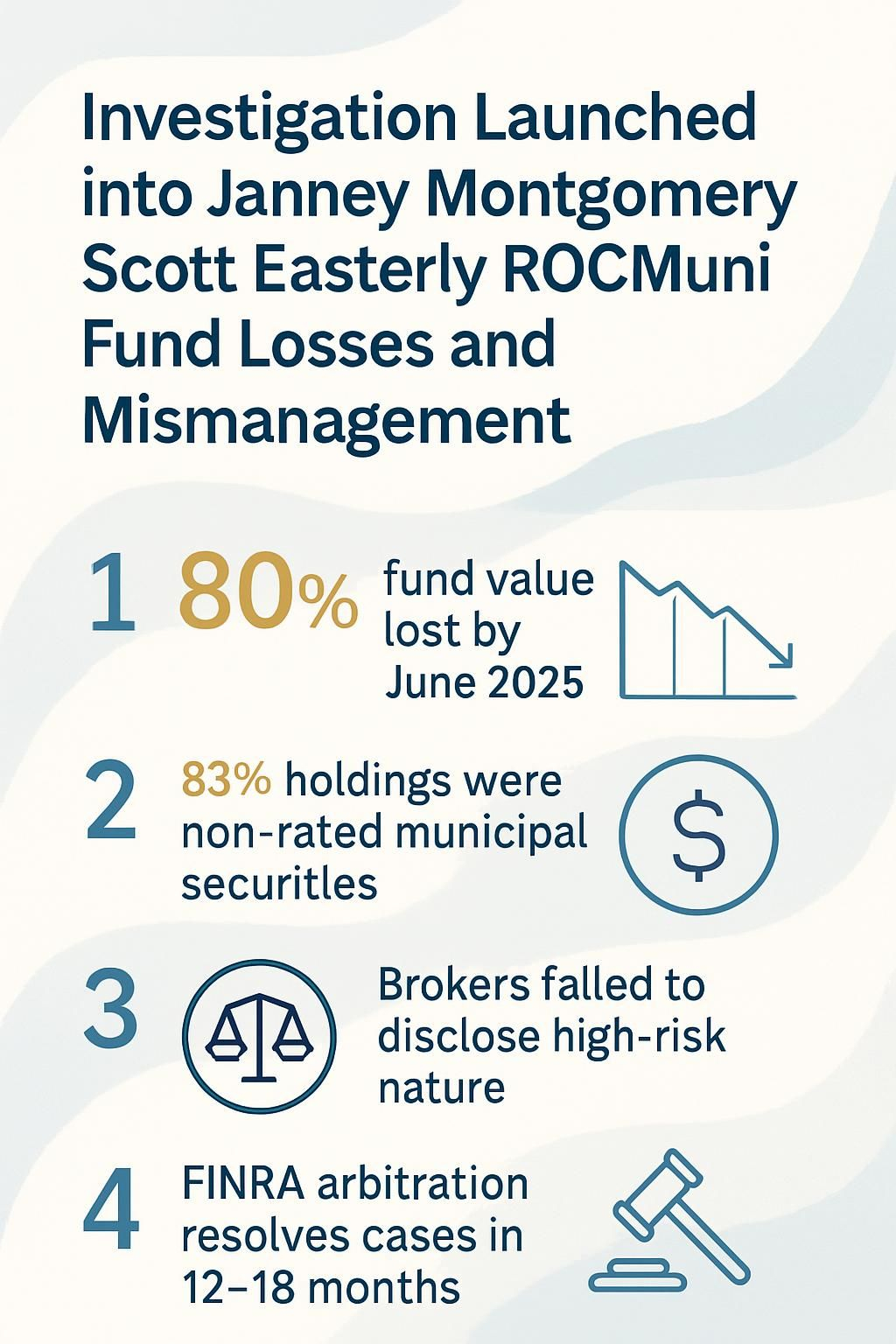
- The Janney Montgomery Scott Easterly ROCMuni Fund lost 80% of its value, dropping from $6.36 to $3.09 per share in June 2025.
- Nearly 80% of fund holdings were junk-rated bonds or in default, with 83% being non-rated municipal securities creating extreme investor risk.
- Brokers allegedly failed to disclose the fund’s high-risk nature and inappropriately recommended it to conservative investors seeking stable income.
- FINRA arbitration provides faster resolution within 12-18 months compared to lengthy class action lawsuits with minimal investor payouts.
- Haselkorn & Thibaut offers legal representation for investors seeking financial recovery through securities fraud and broker mismanagement claims.
Overview of the Janney Montgomery Scott Easterly ROCMuni Fund Losses
Following the introduction of this concerning situation, the specific details of the Janney Montgomery Scott Easterly ROCMuni Fund losses reveal a dramatic collapse that shocked the investment community.

The fund’s Net Asset Value plummeted from $6.36 at the start of June 2025 to just $3.09 by month’s end, representing massive financial losses for investors. RMHIX shares experienced their worst single-day performance on June 13, 2025, when they crashed over 30% from $6.15 to $4.33.
Total net assets tell an even more alarming story, shrinking from $232 million as of March 31, 2025, to less than $17 million by July 8, 2025.
Portfolio holdings exposed investors to extreme default risk and credit quality concerns that many did not fully understand. Over 83% of the investment fund consisted of non-rated municipal bonds, making proper risk assessment nearly impossible for average investors.
Nearly 80% of holdings carried junk bond ratings of BB+ or lower, with many securities already in default. The fund concentrated over 50% of assets in Rule 144A private placements, creating severe illiquidity problems when investors needed to exit positions.
Childrens Trust Fund Puerto Rico Tobacco Settlement Revenue bonds represented 4.37% of portfolio holdings, demonstrating exposure to high-risk issuers. The year-to-date return reached a devastating -56.44% as of August 1, 2025.
Mismanagement Allegations and Broker Responsibilities
These significant losses have led to serious allegations against brokers and their firms. Critics claim the fund’s prospectus failed to disclose significant risks, including illiquidity, lack of diversification, and flawed pricing.
Allegations include brokers failing to inform clients of the fund’s junk bond and high-risk nature. Investigations focus on whether the fund was inappropriately recommended to conservative investors or retirees seeking stable income.
Brokers face scrutiny for possible lack of due diligence and prioritization of commissions over client interests. Osaic and Janney Montgomery Scott are regulated by FINRA, which mandates investment suitability based on client age, finances, objectives, and risk tolerance.
There are claims of excessive asset concentration in the fund by brokers. Janney Montgomery Scott was previously charged by Massachusetts’ Secretary of the Commonwealth for inadequate supervision of a broker who generated nearly $200,000 in fees from high-fee mutual fund trading.
The Massachusetts Securities Division required Janney to hire an independent compliance consultant and compensate affected investors.
Importance of the Ongoing Investigation
The ongoing investigation protects investors across all share classes: RMJAX, RMHIX, and RMHVX. Investors discovered significant fund losses after receiving their June 2025 account statements.
This investigation helps determine if brokers failed to meet their responsibilities when recommending high-risk investments. Legal representation becomes essential for investors seeking financial recovery through proper channels.
FINRA arbitration offers a faster path to resolution, typically completing cases within 12 to 18 months. Class actions often drag on for years with minimal payouts for affected investors.
Arbitration allows for individualized claims that may result in higher damages. Complaints filed through this process give investors better chances of achieving full or partial financial recoveries.
Understanding your legal options helps determine the best approach for pursuing compensation.
Conclusion
This investigation reveals serious fund mismanagement and potential misrepresentation by major broker-dealers. Investors face substantial losses from speculative investments that were marketed as safe municipal bonds.
Securities professionals must fulfill their duty to recommend suitable investments based on proper risk assessment. Haselkorn & Thibaut (investmentfraudlawyers.com) provides experienced legal representation for investors seeking recovery through FINRA arbitration proceedings.
Taking swift legal action protects your rights and maximizes your chances of financial recovery. Your investment losses deserve professional attention from attorneys who understand complex securities fraud cases.
Correction or Updated Info Needed? The information in this article includes the publisher's opinion and is based on publicly available materials believed to be accurate at the time of publication.
We welcome updates. If you have personal knowledge of additional facts or details related to any issues or individuals, and you believe that information would enhance the accuracy of the article, don't hesitate to get in touch with us https://financialadvisorcomplaints.com/article-correction-update/ and provide you name, address, email, and telephone contact for follow-up reporting, along with the back-up for any updates. The publisher strives to provide the most up-to-date and most accurate report regarding all issues and events, and welcomes input from any individuals with personal knowledge.
DISCLAIMER: The information herein is derived from public sources and is provided "as is" without warranty of any kind. Legal matters may have subsequent developments, and market values may fluctuate. While we strive for accuracy, we make no representations about the completeness or reliability of this information. Readers should independently verify all content and seek professional advice as needed.


